Rising fuel prices are exposing Australia’s reliance on cars and trucks. Here’s why shifting to rail freight, public transport, and electrified rail reduces costs and fuel dependence.
Australia’s fuel situation right now is a bit of a wake-up call.
As global tensions push up oil prices, we’re all starting to feel it—at the petrol pump, in grocery prices, and even in the cost of building roads and housing. But what’s becoming clearer is that this isn’t just a short-term spike. It’s exposing how dependent our transport system is on fuel.
You can already see small signs of change. In Sydney, train use has ticked up by around 2–6% in recent weeks, while traffic on some major roads has dropped slightly—about 1–5%. That might not sound huge, but it tells us something important: when driving gets more expensive, people will switch—if there’s a good alternative.
And that’s the key issue. For a lot of Australians, there isn’t.
Right now, our transport system leans heavily on cars and trucks. Transport uses about 70% of Australia’s liquid fuel, most of it in road vehicles. So when fuel prices go up, it doesn’t just hit drivers—it flows through everything. Freight gets more expensive. Construction costs rise. Everyday living costs creep up.
That’s why this moment matters. It’s not just about managing higher prices—it’s about reducing how exposed we are in the first place.
One obvious place to start is freight.
Rail is simply more efficient for long-distance transport. It can move goods using about one-third of the fuel per tonne-kilometre compared to trucks. That’s a huge difference, especially when diesel prices are volatile.
We already use rail well for bulk freight like coal and grain. But most everyday goods—food, retail, parcels—still travel long distances by truck. That means we’re relying on the most fuel-intensive option for a lot of what we consume.
Shifting more of that freight onto rail wouldn’t just cut fuel use—it would also make supply chains more stable and less sensitive to global shocks.
But there’s another step we need to take if we’re serious about reducing fuel dependence: electrifying the rail network.
Right now, a lot of freight trains in NSW still run on diesel, even on major corridors. Electrification changes that completely. Instead of relying on imported fuel, trains can run on electricity generated here—especially as more renewables come online.
And the good news is we’re not starting from scratch.
There are some clear, practical projects that could make a big difference:
- Extending electrification from Lithgow to Parkes, linking the Sydney network to a major inland freight hub
- Electrifying the Main South line from Sydney toward Junee and eventually Melbourne
- Expanding electrification on the Main North line beyond Newcastle towards the Hunter and Brisbane
- Making better use of the already electrified Illawarra line for freight to Port Kembla
- Connecting electrified rail into freight hubs like Moorebank and Western Sydney
These aren’t blue-sky ideas—they build on existing rail corridors. That makes them one of the more practical ways to reduce diesel dependence at scale.
Passenger transport is the other half of the story.
Australians travel well over 100 billion passenger-kilometres by car each year, often because they don’t have much choice. That creates a kind of lock-in—where people have to drive, even when it’s expensive.
But we’re already seeing that behaviour can change. As fuel prices rise, more people are using trains. The question is how to support that shift.
One of the simplest ways is through pricing.
Making public transport cheaper—especially during periods of high fuel prices—can take real pressure off households. Ideas like a 50-cent fare trial aren’t just nice in theory—they can actually encourage people to leave the car at home, even if just for some trips.
If that’s something you think makes sense, you can support it here:
👉 https://actionnetwork.org/letters/lets-have-a-50-cent-public-transport-fare-trial
Of course, affordability alone isn’t enough. Services also need to be frequent, reliable, and well connected. But when those pieces come together, people do make the shift.
There’s also a fairness angle here that’s easy to miss. Rising fuel prices hit hardest in outer suburbs and regional areas, where people often have no option but to drive. Better public transport—and better planning around it—gives people real choices instead of forcing them into higher costs.
None of this means getting rid of cars or trucks. They still play an important role, especially for local trips and deliveries.
But we need to be smarter about how we use each mode.
Rail—especially electrified rail—should be doing more of the heavy lifting for long-distance freight and high-capacity travel. Public transport should be the backbone of how our cities move. And cars should be one option, not the only option.
We can’t control global fuel prices. But we can control how much they affect us.
Right now, we’ve had a glimpse of what happens when the system is under pressure—and how quickly people adapt when alternatives exist. The challenge now is to build on that, and make those alternatives stronger, more accessible, and more affordable.
Because a transport system that uses less fuel isn’t just better for the environment—it’s cheaper to run, more resilient, and simply works better for everyone.
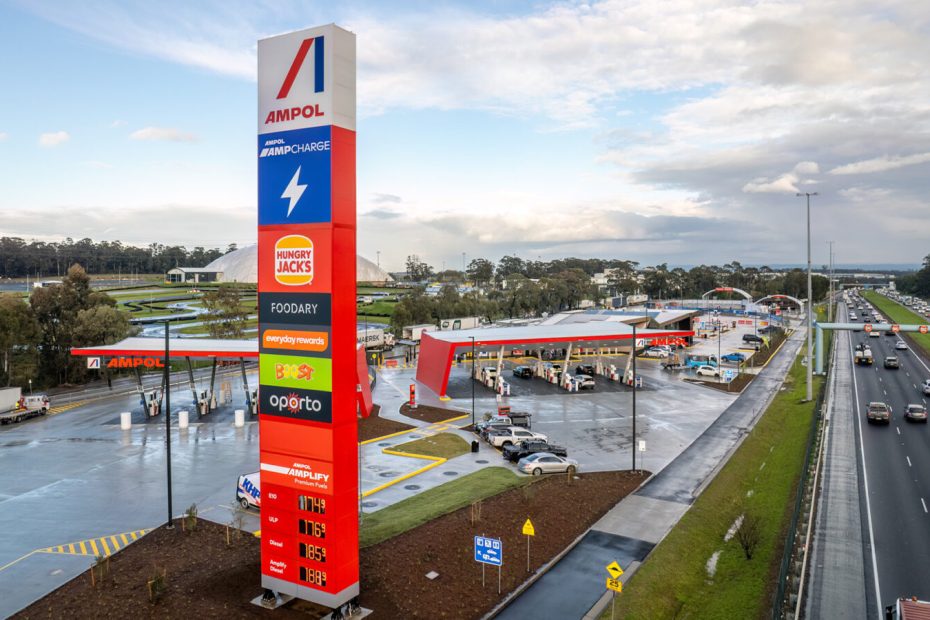
Image: Mainbrace Constructions Retail Construction 2025 Ampol Eastern Creek (CC BY-NC 4.0)