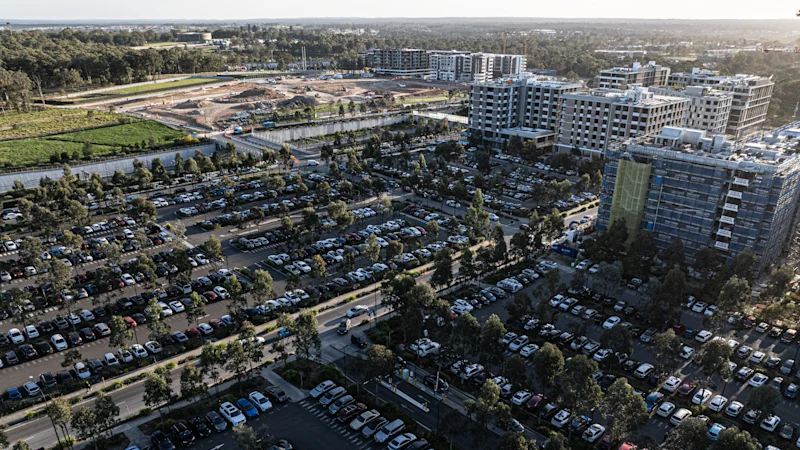
Carparking demand at Tallawong station car park is growing at a rate of 50 per cent a year, the review found. Credit:Nick Moir (SMH)
The Sydney Morning Herald recently reported that Tallawong Metro Station has roughly 2.5 cars for every available parking space, with vehicles overflowing onto surrounding streets. While this statistic is often framed as a parking shortage, it is in fact a systemic last-mile access failure.
One commuter put it simply:
“I would love not to have to drive, but the buses don’t go near my house, so I have no choice.”
This highlights a key principle in transport planning: accessibility to a high-capacity trunk line (like a metro) is often the dominant factor in mode choice, even more than the speed or frequency of the rail service itself. Without reliable last-mile connections, commuters rationally default to private cars.
Parking Expansion Is Not a Transport Solution
Adding more parking may relieve pressure temporarily, but it does not address the underlying cause of car dependency. As UNSW City Futures Research Centre professor Chris Pettit observes:
“Simply adding more car parks to the site is not a silver-bullet solution.”
Excess parking can actually exacerbate congestion by embedding driving as the default travel mode, rather than encouraging a shift to public transport. Another perspective in the article echoes this:
“At some point there needs to be a cap because, if you keep building more car parks, all that will do is encourage more people to drive and you’ll end up with the same situation we have now.”
From a technical standpoint, building parking increases capacity for cars but does not reduce the generalised cost of access to transit, which includes walking time, wait time, and transfer reliability — all critical determinants of travel behaviour.
Frequency and Reliability Are Core Last-Mile Metrics
High-frequency last-mile transit is a capacity and reliability infrastructure. Transport modelling shows that headways longer than 15–20 minutes sharply increase the perceived cost of public transport, particularly for short feeder trips. For example, a commuter missing a 30-minute bus effectively experiences a 30-minute wait, compared to a few minutes if the service runs every 10 minutes.
At Tallawong, insufficient feeder frequency means that even a metro line operating at high service levels cannot fully relieve car demand. High-frequency buses aligned with metro schedules reduce perceived wait time, improve reliability, and increase mode share for public transport.
Operating Hours Must Mirror Metro Services
Another critical dimension is temporal coverage. Limited operating hours for last-mile buses force commuters to drive outside peak times, for evening shifts, weekend trips, or early morning travel. For an effective last-mile network:
- Feeder buses should match or exceed metro operating hours,
- On-demand or microtransit solutions can supplement low-demand periods,
- Active transport infrastructure ensures all-hour access within a reasonable catchment.
Active Transport Extends Station Catchments
Walking and cycling can significantly expand station catchment areas at low cost. However, technical considerations matter:
- Protected cycling lanes and continuous sidewalks increase safety and directness, reducing friction for first/last-mile travel,
- Secure, weather-protected end-of-trip facilities improve the utility of non-motorised access,
- Integrated micro-mobility solutions (e-bikes, shared scooters) can cover gaps between home and station.
Effective active transport reduces the number of commuters relying on parking while supporting higher metro throughput.
Global Best Practice Supports Last-Mile Investment
As noted in the Herald article:
“Instead we need to look at cities like London and Amsterdam, which have metro systems that don’t have any commuter car parking at all. What they have instead are excellent rapid public transport options and cycleways that connect metro systems to the areas where people live – that means people don’t even have to consider driving in the first place.”
These examples reinforce that well-integrated, high-frequency last-mile transit networks and active transport infrastructure are far more effective than adding parking for reducing car dependency.
Conclusion: A Last-Mile-First Strategy
Tallawong’s parking pressures are not a metro failure; they are a symptom of inadequate last-mile planning. To reduce car dependency in Sydney, planners must:
- Prioritise high-frequency, reliable last-mile bus networks,
- Ensure operating hours match metro service,
- Invest in safe, continuous walking and cycling infrastructure,
- Incorporate last-mile connectivity metrics into project evaluation, not just parking counts.
From a technical standpoint, focusing on last-mile solutions reduces the generalised cost of public transport, expands catchment areas, and increases mode share — delivering sustainable, long-term benefits far beyond what additional parking can achieve.
Read the Sydney Morning Herald article “The Sydney metro station where there are 2.5 cars for every parking space” (17 December 2025)